CONSTRUCT
Overload vision. What you see, you did not choose.
Close your eyes and try to see a sunrise. You will succeed — within limits. The image will be approximate, soft at the edges, available only as long as you keep summoning it. Try to see something you did not choose, something you cannot recognize, something that arrives on its own — and you will discover the line you cannot cross with effort. That line is the editor. The editor selects every image you have ever consciously seen. It does it well enough that you forget it is there. Past it is a different mechanism — the image-field that generates dreams, that you cannot turn off at four in the morning, that psychedelics open chemically. CONSTRUCT does not borrow from chemistry. It engineers a gate.
What it does
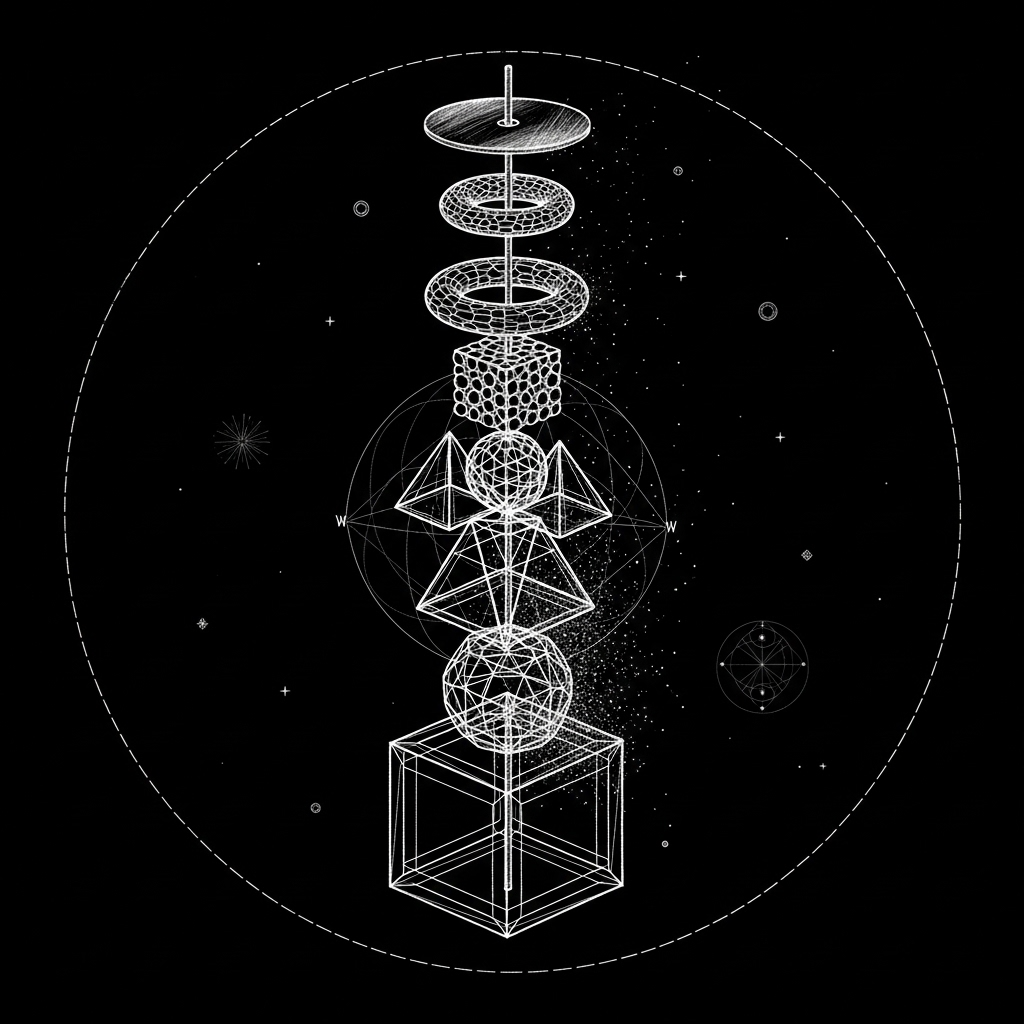
The visual cortex has a holding capacity. Like working memory, it has a ceiling — a number of distinct elements it can keep simultaneously active. Beyond that ceiling, the editor that normally curates what appears can no longer fit the load, and the auto-management system that runs underneath it steps in. This is the same system that runs hypnagogic imagery at sleep onset and dream content at night. It is autonomous. It does not need you. CONSTRUCT brings you to its threshold deliberately, on schedule, sober, and lets you stay there for several minutes. The method is straightforward to describe: you build a structure of increasing complexity inside the eyes, each new element added to the previous ones, holding them all together until the holding fails. What appears after the failure is the content of the protocol. The vault page contains the exact sequence, the elements, and the markers that tell you you are on track.
What changes
For five to ten minutes during the run you are not the director of what you see. The images are vivid, often complex, sometimes unrecognizable; sometimes recognizable but at angles the editor would never have shown you. They are not symbolic. They do not ask to be interpreted. They simply arrive. The state ends as cleanly as it began — eyes open, the room, the chair, the morning. The image-field closes. What remains is a quiet adjustment: imagination during the day feels less brittle, and the next dream often carries a continuation. After three to four sessions the access becomes practical — a state you know how to find when you need it.
Where you run it
A dim or dark room. Seated upright, alone, eyes closed for the full duration. Morning, when you are in resource. Twenty to thirty uninterrupted minutes; thirty more of quiet afterward. The protocol is not for operators with a history of epilepsy, psychotic disorders, dissociative disorders, or severe anxiety states. CONSTRUCT loads cognition deliberately; an unstable substrate will be loaded too.
Where it fits in the series
CONSTRUCT is the third protocol of OVERLOAD GATE — the longest of the four and the most demanding. DRIFT trained body-load competence; FLOODGATE trained speech-load competence; CONSTRUCT trains vision-load and opens the territory the rest of the series points to. After CONSTRUCT, IMPRINT runs the dual collapse — speech and vision together — and uses the brief silent window that follows to install one chosen statement into the body. IMPRINT does not work without CONSTRUCT. The image-field competence trained here is half of what IMPRINT runs on.
Heritage
Twelve hundred years across multiple visualisation lineages. Tibetan generation-stage practice uses a related principle for very different ends. Hermetic and certain Sufi orders developed forms of nested visual construction that point at the same gate. The protocol is not a translation of any of these. It is the engineered minimum — the smallest set of operations that reliably produces the result. No vocabulary required, no tradition required, no faith required. A method.
OVERLOAD GATE
For the practitioner who already tried the quiet way.